
832.781.8343

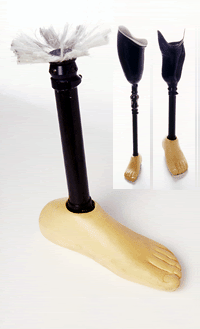
Dycor pylons are elastic fiberglass/epoxy advanced composites. Elasticity is primarily determined by overall length and five variations of wall thickness ranging from .065 to .125”.

|

|
Foot/shank lightweight kinesigenic prosthetics
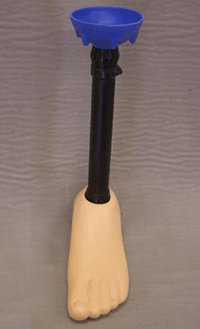
Omnidirectional Trylon™ elastic pylons (patent pending) and an integrated balanced leaf spring energy-returning foot (patent pending) provide unprecedented non-articulated weight-bearing foot and ankle motion in all three planes (Fig. 3 and 4). Increased range of contingent weight-bearing motion enhances proprioceptive, somatosensory, and sensorimotor function. The unique qualities of the triple helix Trylon structure protect the residuum in the same way a double helix structure protects DNA sequencing. This biomechanical approach to prosthetic gait management is defined as kinesigenics, or kinesigenic gait management. Transfer alignment of preparatory to definite components includes the shoe.
Component selection and integration
Trylons and leaf spring feet are a monolithic structure pre-set in a non-adjustable neutral ankle position. Flexibility and resiliency are paired and matched to GRF parameters specified by the attending prosthetist. Socket integration is either the socket adaptor (Fig. 3) or the socket receptacle (Fig. 4) method. The socket adaptor method expedites detachment, foot shell replacement, and rotation adjustment. The socket receptacle method is utilized for longer residual limbs and is lighter and less expensive. Trylon systems cannot be used with OTS pin suspension liners or when gait pathology, such as knee instability, is present. (see more)
Dycor Manufacturing, Inc. 2711 Cartwright Road Missouri City, TX 77459 ph: 832.781.8343
© 1997 - , Dycor Manufacturing Inc., All rights reserved.